
Got Chamazulene?

Have you ever opened a bottle of Blue Tansy or German Chamomile and thought, How in the world is that color natural?

That gorgeous, almost unbelievable sapphire blue comes largely from a fascinating constituent called chamazulene. And while the color certainly gets your attention, what chamazulene does is even more impressive.

Chamazulene is best known for two things we REALLY like to see when we’re talking about healing and irritated tissue: anti-inflammatory and antioxidant activity.

In other words, when skin is red, angry, itchy, tender, damaged, or simply having a very bad day, chamazulene is one constituent worth knowing about.

First, It Helps Calm Things Down

Inflammation isn’t necessarily the enemy. It’s actually part of the body’s normal healing response. You get injured, irritated, or exposed to something your body doesn’t like, and your immune system sounds the alarm.

That’s a good thing.

The problem is when that alarm keeps blaring.

Excessive or prolonged inflammation can mean more redness, swelling, itching, tenderness, and irritation—and potentially make it harder for tissue to settle down and get on with the business of repairing itself.

So if you’d like to geek out with me for a minute, this is where chamazulene gets really interesting.

Researchers have found that chamazulene can inhibit the formation of leukotriene B4 (LTB4).

Never heard of it? That’s okay. Think of LTB4 as one of the body’s inflammatory “COME QUICK!” signals. It helps call immune cells to an area where they’re needed.

Again, that’s useful when there’s a genuine problem. But too much inflammatory signaling can contribute to an excessive inflammatory response.

In lab research, chamazulene inhibited the formation of LTB4 in a concentration-dependent manner. Researchers have suggested that this action may help explain some of chamomile’s long-recognized anti-inflammatory properties.

And suddenly that little blue bottle starts looking a whole lot more interesting.

But Chamazulene Doesn’t Stop at Inflammation

When tissue is irritated or damaged, inflammation isn’t the only thing going on. There’s often oxidative stress happening too.

Oxidative stress occurs when highly reactive molecules—often called free radicals—begin to outpace the body’s antioxidant defenses. Too much of that activity can damage important cellular components, including lipids.

Here’s where chamazulene gives us another reason to pay attention.

It has demonstrated significant antioxidant activity and has been shown experimentally to inhibit lipid oxidation.

So while its anti-inflammatory activity may help calm an overly enthusiastic inflammatory response, its antioxidant activity may also help protect vulnerable tissue from oxidative damage.

That’s a pretty impressive résumé for one blue plant constituent.

So…Which Essential Oils Have Chamazulene?

Now for the practical part.

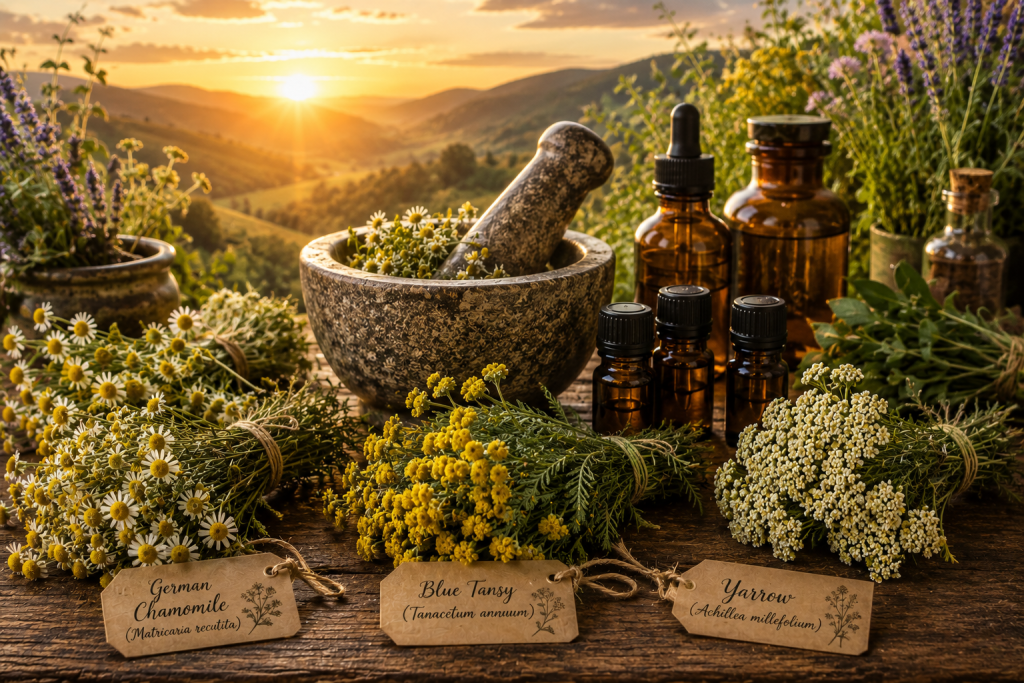
If you’re thinking, Okay, Stacy, which bottles do I actually look for? Here are three of the big ones:

💙 German Chamomile (Chamomilla recutita)

German Chamomile is one I especially think of when dealing with irritated, inflamed, itchy, tender, or stressed skin. And chamomile itself has research supporting its traditional use in inflammatory skin conditions and wound care.

One interesting detail: chamazulene isn’t sitting inside the fresh chamomile flower waiting to be bottled. The plant contains compounds such as matricin, which are transformed during steam distillation into chamazulene.

In other words, some pretty amazing chemistry is happening inside that still!

💙 Blue Tansy (Tanacetum annuum)

If you’ve seen Blue Tansy, you already know why it belongs on this list.

THAT BLUE.

Blue Tansy oil is famous for its rich sapphire color, and it’s become a favorite in soothing skincare formulations—particularly when the goal is to calm the appearance and discomfort of red, irritated, stressed skin.

It’s also a wonderful reminder that the blue color doesn’t come from the flower itself. Blue Tansy actually has yellow flowers!

💙 Yarrow (Achillea millefolium)

Yarrow is another fascinating one because its chemistry can vary considerably.

Certain Yarrow chemotypes contain significant amounts of chamazulene and produce that unmistakable blue essential oil. Yarrow also has a very long history of traditional use in preparations for the skin, making its chamazulene content particularly interesting.

The Beauty Behind the Blue

This is one of the things I love most about learning essential oil chemistry.

Once you begin understanding the individual constituents, you stop looking at a bottle and simply thinking, “Oh, this one smells nice.”

Instead, you begin asking:

What’s actually IN there? What are the constituents and what are they doing? How has this particular plant been used for generations?

Chamazulene gives us a wonderful example.

We’re looking at a constituent with demonstrated anti-inflammatory and antioxidant activity, fascinating research surrounding inflammatory signaling and oxidative stress, and a connection to plants that have been traditionally valued for soothing and caring for troubled skin.

And it just happens to turn our essential oils an absolutely spectacular shade of sapphire blue.

So the next time you open German Chamomile, Blue Tansy, or a chamazulene-rich Yarrow and see that extraordinary color, you’ll know there’s a whole lot more going on in that bottle than meets the eye.

Blue is beautiful! 💙

Leave a Reply

Your email address will not be published. Required fields are marked *